

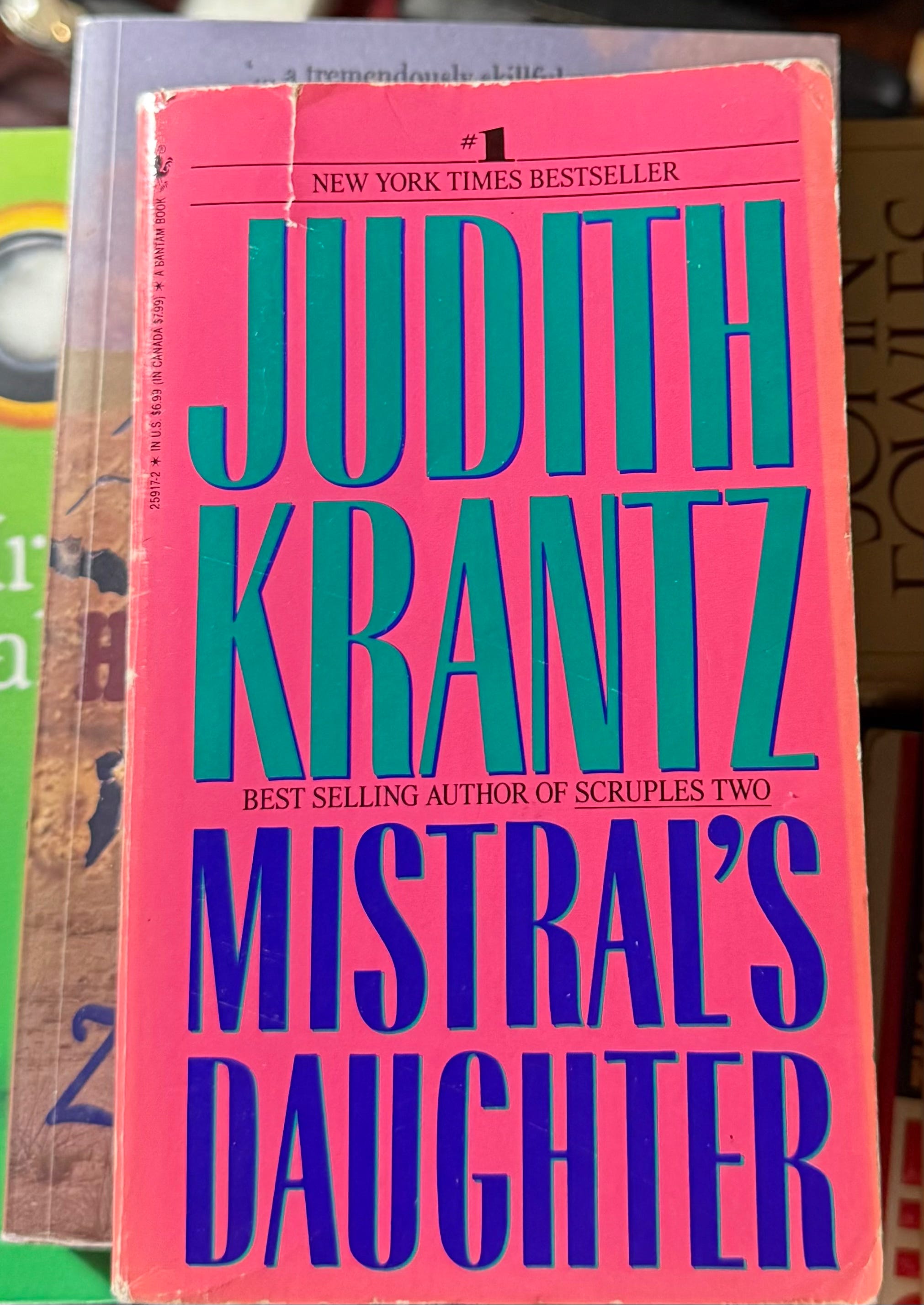
I am racking my brain what if anything I found remarkable in this book. Maybe the somewhat incestuous constellation of ‘three generations of magnificent, red-haired beauties bound to a single, extraordinary man’ (quote from back cover), painter-genius Mistral (what he paints seems modelled on Chagall)? Just to get this out of the way: The first beauty is his Jewish model Maggy (‘he wiped his paint-smeared hands on her pubic hair’). The second beauty is Maggy’s daughter Teddy, fathered in an affair with a guy named Kilkullen whose catholic wife refuses a divorce—but then Kilkullen dies to not further complicate the plot. Teddy rapidly grows into an awe-inspiring word-class fashion model (‘a sense of authentic existence, nothing less, was what Teddy produced for the camera’) and, at a photoshoot in Mistral’s studio, the artist, without asking, wipes away her false eyebrows, ruining hours of careful make-up. Teddy is literally swept away (‘none of the men in her life had seemed to know that she wanted to be told what to do, yes, even to be ordered to do it’). Mistral leaves cold and calculating wife Kate, and all-too-short happiness with Teddy ensues. Teddy gives birth to the third red-haired beauty, love-child Fauve (yes, like the art movement) and then quickly dies to not further complicate the plot. Mistral (or the book) espouses a rather retrograde view of ‘the filth of the entire world of art’, the ‘cesspool of so-called new ideas,’ lecturing his daughter Fauve: ‘…but surely you don’t take people seriously who make “art” from fluorescent light tubes and modular shelving and Styrofoam and comic strips and things they find in garbage cans.’ Having done some research, Fauve accuses her father that during the Vichy regime, he did nothing when Jewish artists seeking a hide-out knocked at the doors of his Provencal estate. After Mistral’s death, Fauve will find his last ‘enormous paintings: the ‘pagan brush’ of the repentant master has integrated Hebrew inscriptions among ‘crowned lions rearing into the air, lambs cavorting, gazelles prancing and doves swooping about, all against a tangled brilliance of jewel-bright wild flowers apple trees, the green of peridot and celadon…’ (the descriptions run on and on), so that ‘something deep in Fauve opened and finally understood: Julien Mistal had crossed the green fields of time and lived in old Jerusalem.’