

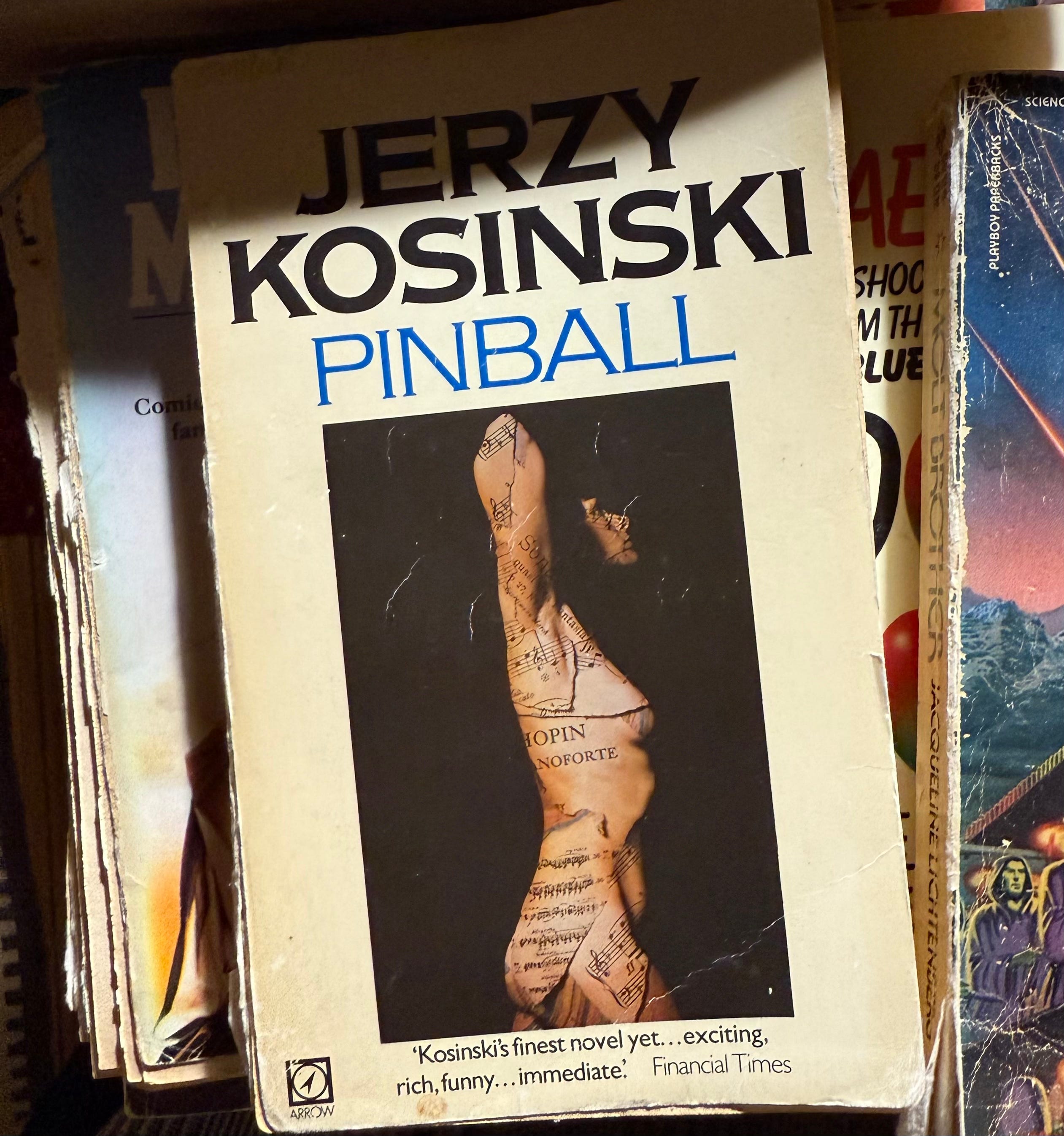
The book that started it all. In a Cavett show eight years before its publication, where Konsinski, together with Antony Burgess and Barbara Howar, is supposed to review Cavett’s book Cavett, the show’s host says, quizzed by Kosinski about his plans for the future: ‘I never had a plan for my life. That’s what makes me hard to figure out about myself. (…) I’ve never had this plan. I’ve always felt that I was like the ball in a pinball machine that sort of went on a logical route but only after you’d looked at it afterwards.’ Was this moment perhaps the seed for Pinball? I found a German translation in a book exchange box in front of a church in Veddel, noted the publication date, and everything slowly took off from there. For no other reason I settled for 1982 as publication date of all sources. I ordered the original. (It has to be said that as a novel, Pinball sucks.) The next two books were Gardner’s Mickelsson’s Ghosts and Paretsky’s Indemnity only. At that point, I was more concerned with permutations, transpositions, re-orderings and reversals of material from just a few books, even allowing more generous changes and the addition of self-written sentences, not yet having a clear overall concept in mind. Pinball contributes the incestuous undercurrent, the necrophilia, the postponement, the teasing and withdrawal. I merged the anonymous group sex in the underground joint Dead Heat with Ortiz-Taylor’s underground mummies in Guanajuato and Bellow’s domed crematorium in Bucharest in The Dean’s December. For Kosinski, the novel served a platform on which the formerly respected author damaged by rumors that he stole other writers’ work could air his grievances, transposed to the field of music and the theft of musical themes. Plagiarism. The threat to identity is located in the source of expression, in the artist’s strange voice resulting from surgery: ‘The tumor was between the larynx and the pharynx (…) Along with the nose and mouth, those are the parts of the throat that determine how our voice sounds.’ The between is typical. It is always uneasy. ‘Even though he was thoroughly convinced that no one would ever identify his voice as Goddard’s, he always felt a shiver of apprehension.’ You can sense this frisson of being found out, coupled with fear, in many passages. The close tie of attraction and repulsion and the resulting deep unease permeate the book. The second challenge is chance, again put forward with both admiration (Stockhausen is mentioned several times) and disdain: ‘Above all, to Donna, Goddard was an aleator, a musical dice thrower, who thought musical meaning in nihilistic spontaneity and depended for his effect on free-wheeling macronic improvisation.’