

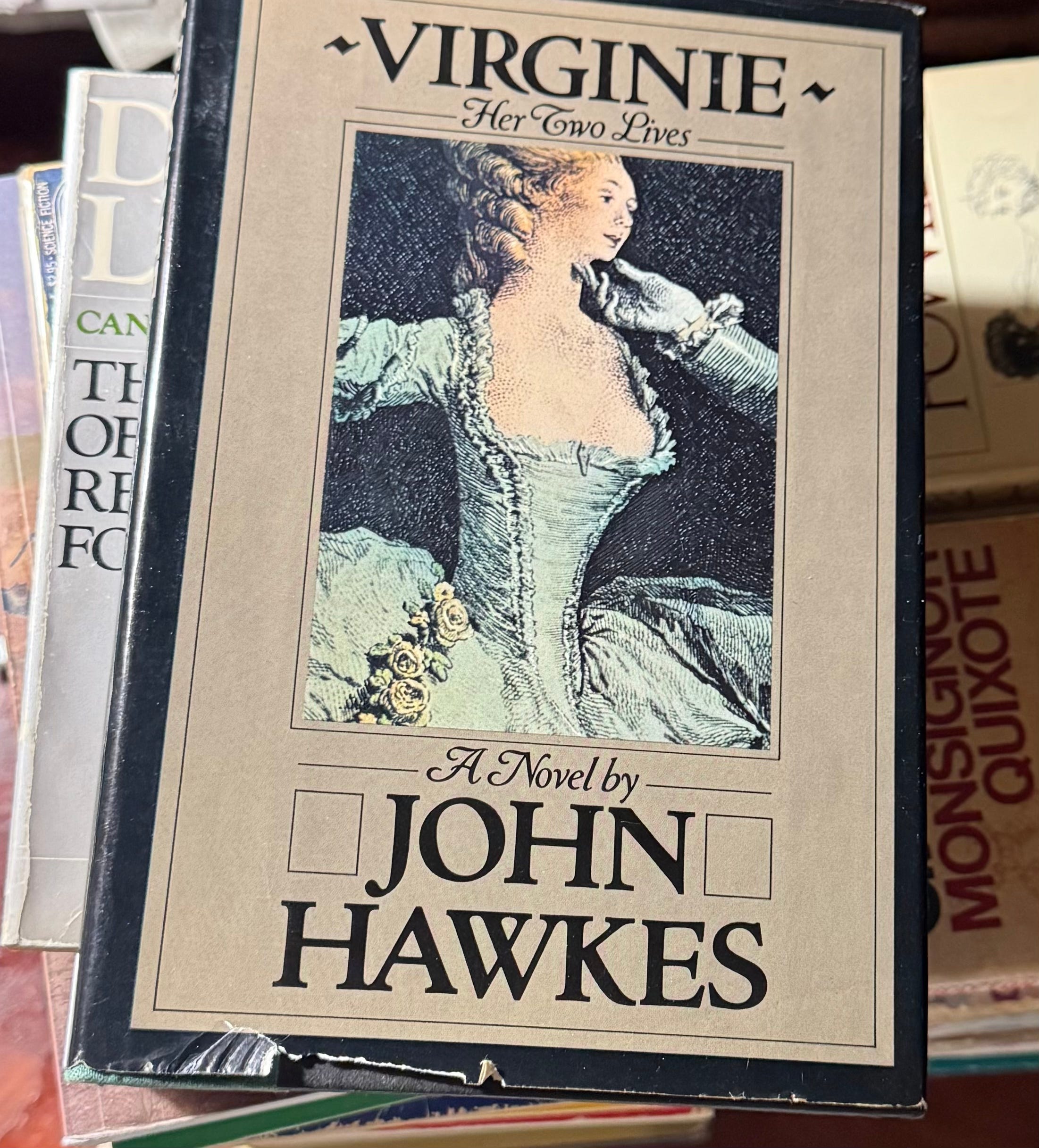
In any attempt of prolonged reading, I find myself wound up, restless and allergic to the style that fills these pages, consciously precious, wordy and frilly, with muted echoes of Bataille. Could the fact alone that I cannot but balk at it be a mark of some quality? Hawkes, it seems, knows exactly what he’s doing, he is no fool. In the blurb, Robert Coover (author of Spanking the Maid, another book in the set) thinks ‘the secret subtext of this entire book’ might be the words that ‘dying at the stake, Le Seigneur, the eighteenth-century voluptuary herein, cries out to the child-heroine (…) “Virginie! Destroy your innocence”.’ Hmm. Is that even possible? Would such agency not contradict innocence? Or is that the sweet paradox, the essence of the subtext? There might be something, some quality, that is incompatible with my sensorium. So I throw up my hands and escape to a longish quote, more or less picked at random, to give a taste of the thing: ‘On Sylvie’s face sat helpfulness itself and of course on her upturned little palm sat the cake of soap. Her arm was extended. Hand and arm were dripping. Her head was tilted, her chin raised, her eyes and smile bespoke a small triumph Monsieur Pidou was meant not to fear. But never had there been such soap! Never had mere soap assumed such properties! Mere soap it was, but what a forbidden glossy egg on Sylvie’s palm! How could she so ingenuously offer him the soap, knowing as she must that once he trusted his awkward fingers to close on the slippery cake, which might well slip away once more in his agitation, he would enter into a bargain with Sylvie defined not by what the soap actually was but by what it meant? So much was undeniable. The two of them might have been in a bath together!’