
Margaret Yorke: Devil’s Work
One hundred novels of 1982 (99)

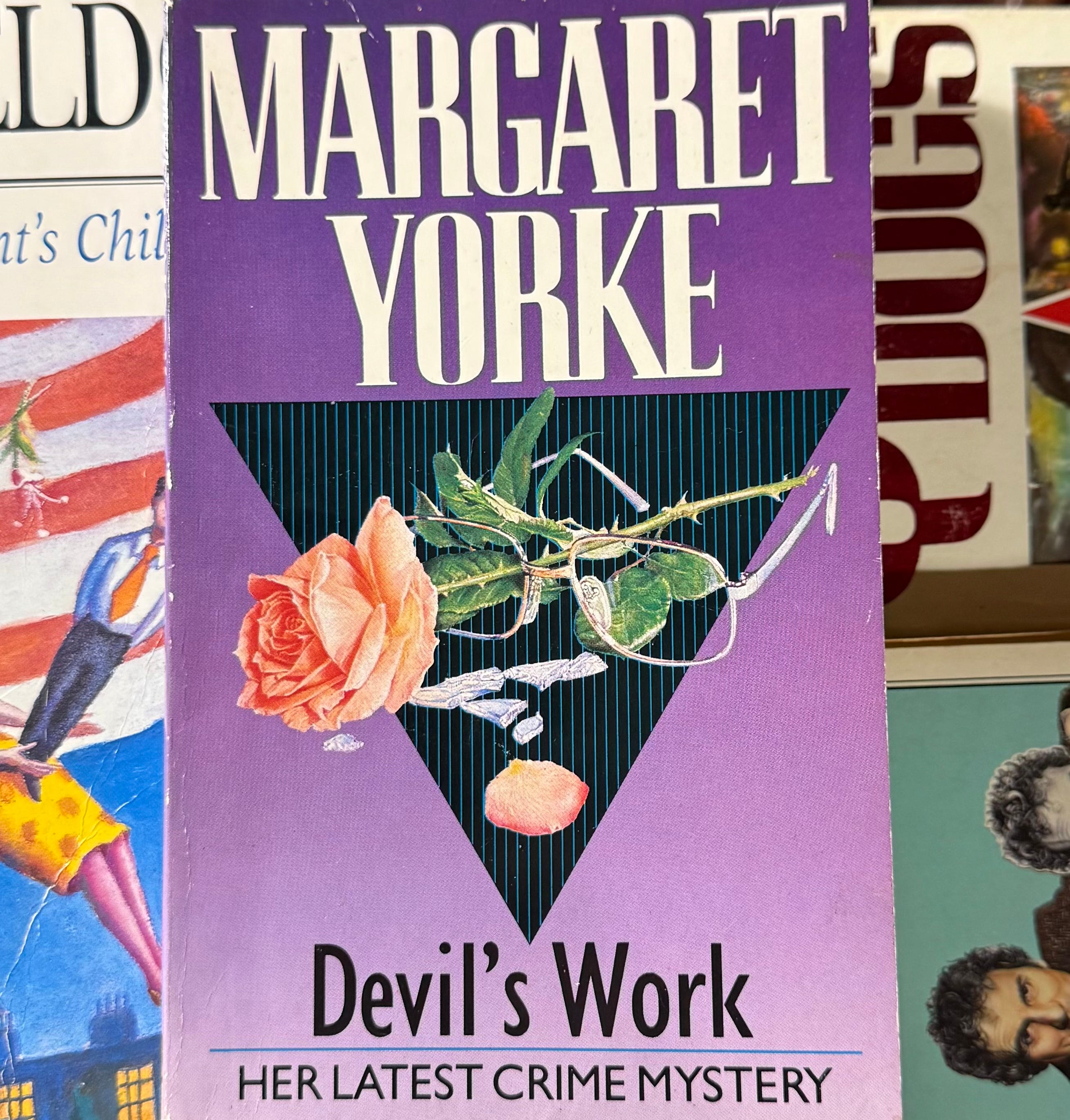
The story, somewhat misnamed and rather flatly told with bit of local English colour, results from two or three intersecting storylines. The first features Alan Parker, a regular guy, friendly, slightly dull, who loses his job and does not tell his wife in the hope he can clinch another job first; a guy who now has time to waste since he still pretends to go into his office, and through a chance encounter gets interested in, or concerned about, ‘a waif-like little girl’ (back cover) who has to walk home from school on her own. The second storyline features the little girl’s mother who has been left deeply depressed after the death of her husband, working odd jobs and now caring for the little girl, Tessa, all on her own while being really too sick to manage. And then there is a pensioner, Mrs. Cox, in the souterrain of the same house, who occasionally babysits Tessa. — After following Tessa in his car to make sure she arrives home safely, Alan will get out the drawing pad: ‘Alan went into his study and put on his new recording of Trovatore. While he listened to it, he did some sketches, in pencil, of the small girl he had seen that day. He drew well…lightly shading the hollows behind her thin little knees in a sketch of her walking away from the viewer. There would be plenty of time for study.’ This sets up a suspicion the novel keeps alive less than half-heartedly, because it seems very obvious that Alan is the good guy even as he begins seeing Tessa’s mum Louise, thereby betraying his own wife. Then Tessa disappears. The police is informed and conducts a search, also probing Alan. We are told that the old pensioner Mrs Cox has cared for many children; that she has served time; that she has been living with a certain Mavis, now dead (Louise’s mum also lives with another woman, a fate the book lends a hint of damnation). An ugly secret is mentioned: ‘Sometimes, by mistake, Mrs Cox would call Tessa by her name. “Grace,” she’d say, and Tessa would stare. But Tessa was older than Grace had been when it happened.’ It? More information is slipped in a bit later: ‘Mavis had saved her then. Hers was the only friendly hand extended to Mrs Cox. She’d been attacked more than once, because of her crime. There was no tolerance, in the prison, towards those who harmed children.’ Grace’s mother had had an affair. ‘Mrs Cox had found out what was going on … Mrs Cox had been thoroughly shocked but had known at once where her duty lay. The mother must be taught a lesson and the child’s innocence saved.’ Since Louise from upstairs now seems to be seeing this new man, neglecting Tessa, the pattern is repeated. Hhm. That is really all I can find to say.